
![Tadalafil vs Sildenafil Effectiveness: A UK Clinical Comparison [2026]](https://getautoseo.com/storage/hero_images/article_681719_1776514276.jpg)
Choosing the most famous blue pill might actually be the least effective choice for your specific lifestyle and relationship goals. It's a common frustration to feel that your intimacy is dictated by a stopwatch or to worry that a medication might fail at the critical moment. You deserve a solution that restores your confidence without the burden of clinical anxiety or confusion over which generic option offers the best value for your health.
This comprehensive comparison analyzes tadalafil vs sildenafil effectiveness using 2026 UK clinical data to help you identify the treatment profile that matches your physiological needs. Whether you require the 36 hour spontaneity of Cialis or the targeted 4 hour window of traditional Viagra, we provide the evidence based clarity you need to make an informed choice. We will examine success rates, onset times, and side effect profiles to ensure you can access discreet, regulated care from a trusted UK pharmacy with absolute peace of mind.
Key Takeaways
- Understand how PDE5 inhibitors regulate cGMP to restore natural blood flow and support a physiological response tailored to your clinical needs.
- Evaluate tadalafil vs sildenafil effectiveness using clinical trial data, including success rates and the nuances of pharmaceutical potency.
- Compare the "window of opportunity" between Tadalafil’s 17.5-hour half-life and Sildenafil’s 4-hour duration to optimize your treatment timing.
- Identify the specific safety profiles and side-effect nuances of each medication to ensure a high-quality, well-tolerated clinical experience.
- Determine which treatment protocol best suits your lifestyle by assessing sexual frequency and the benefits of a "Daily Tadalafil" regimen for constant readiness.
Understanding PDE5 Inhibitors: How Tadalafil and Sildenafil Work
Tadalafil and sildenafil are the two most frequently prescribed medications in the UK for managing erectile dysfunction (ED). Both belong to a pharmacological class known as phosphodiesterase type 5 (PDE5) inhibitors. While they vary in duration and onset, their primary biological goal is the same: to facilitate a natural physical response to sexual arousal. When assessing tadalafil vs sildenafil effectiveness, it's vital to understand that these treatments don't create an erection out of nothing. They work alongside the body's natural chemistry to improve blood flow to the penile tissues.
The process begins with sexual stimulation, which triggers the release of nitric oxide in the pelvic region. This chemical messenger stimulates the production of cyclic guanosine monophosphate (cGMP). This molecule is responsible for relaxing the smooth muscles in the blood vessels, allowing them to dilate and fill with blood. Understanding How PDE5 Inhibitors Work involves looking at how these drugs prevent the premature breakdown of cGMP, ensuring the physical response remains stable enough for sexual activity.
Sildenafil first entered the UK market in 1998 under the brand name Viagra, revolutionising men's healthcare. Tadalafil followed in 2003, marketed as Cialis. Since their respective patents expired in 2013 and 2017, generic versions have become widely available through the NHS and private clinics. This shift has significantly reduced costs for patients while maintaining the high safety standards required by the Medicines and Healthcare products Regulatory Agency (MHRA).
The Role of PDE5 in the Body
The PDE5 enzyme serves a natural purpose in the body; it breaks down cGMP to return the penis to a flaccid state after physical intimacy. In many men with ED, this enzyme acts too quickly or blood flow is already restricted, preventing a firm erection. Tadalafil and sildenafil temporarily bind to the PDE5 enzyme to stop it from destroying cGMP. It's a common misconception that these drugs act as aphrodisiacs. They don't increase libido or sexual desire; they only provide the mechanical support needed once a man is already's aroused.
Generic vs. Branded Effectiveness
In the UK, strict bioequivalence laws ensure that generic sildenafil is just as effective as the original blue pill. The active ingredient is identical, meaning the tadalafil vs sildenafil effectiveness debate isn't about branded versus generic, but rather about which molecule suits your lifestyle better. Generic tadalafil provides the same 36 hour window as Cialis but at a much lower price point, often saving patients over 60% per tablet. For those interested in the history of these treatments, this clinical guide to Sildenafil offers a deep dive into the UK's most common ED treatment and its transition from a branded breakthrough to a generic staple.
Comparing Clinical Effectiveness: Success Rates and Potency
When evaluating tadalafil vs sildenafil effectiveness, clinical data remains the most reliable benchmark for patients in the UK. Both medications belong to the PDE5 inhibitor class, meaning they work through the same physiological mechanism; however, their success rates and potency profiles vary slightly based on dosage and individual biological response. A comprehensive meta-analysis of Clinical Effectiveness of Tadalafil vs Sildenafil demonstrates that both drugs achieve high rates of efficacy, with neither showing a definitive "superiority" in terms of raw success across all patient groups.
Potency is a term often misunderstood by users. A higher milligram (mg) dose does not equate to a "stronger" effect on the body. Instead, it reflects the amount of active ingredient required to reach a therapeutic threshold. For example, 20mg of Tadalafil is considered roughly equivalent in clinical potency to 100mg of Sildenafil. The choice between them often depends on the desired duration of action rather than the strength of the erection itself.
Statistical Success in Clinical Trials
In rigorous 24-week clinical trials, Sildenafil users reported an improvement in erections ranging from 77% to 84%, with the 100mg dose specifically showing an 82% success rate. Tadalafil shows remarkably similar results, with success rates for the 10mg and 20mg doses typically falling between 75% and 81%. These studies define "success" using the International Index of Erectile Function (IIEF) scores, which measure the ability to achieve and maintain an erection sufficient for sexual intercourse.
Dose-Response Relationships
The standard starting dose for Sildenafil is 50mg, while Tadalafil usually begins at 10mg. Doctors in the UK follow a titration process, adjusting these amounts based on how well the patient tolerates the medication and the results they achieve. If a starting dose is ineffective, a clinician may increase it to 100mg for Sildenafil or 20mg for Tadalafil.
- Sildenafil (Viagra): Available in 25mg, 50mg, and 100mg tablets.
- Tadalafil (Cialis): Available in 2.5mg and 5mg (daily use) or 10mg and 20mg (on-demand).
- Safety Limit: You must never exceed one dose within a 24-hour period to avoid serious drops in blood pressure.
It's common to experience the "non-responder" phenomenon during the first few attempts. Statistics suggest that up to 30% of men don't see results on their first dose, often due to anxiety, timing, or food interactions. Clinical guidelines recommend trying a specific medication at least eight times before concluding it's ineffective. If you're looking for a reliable way to manage your treatment plan, you can explore professional options at SW Pharma to ensure you're using the most appropriate concentration for your needs.
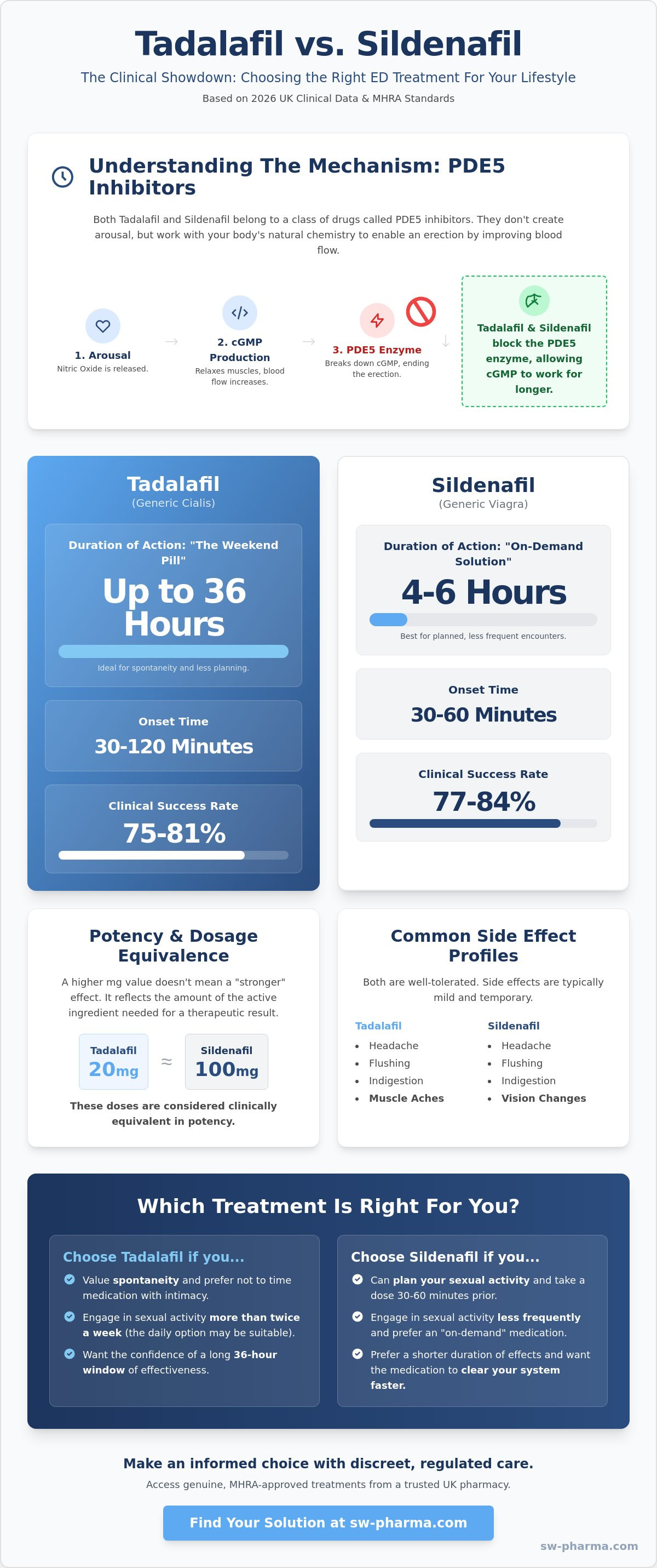
Duration of Action: The 'Weekend Pill' vs. The On-Demand Solution
The physiological difference between these two PDE5 inhibitors hinges on their half-life. Sildenafil possesses a terminal half-life of roughly 4 hours. In contrast, Tadalafil remains active in the system much longer, with a half-life of 17.5 hours. This metabolic distinction is the primary factor when clinicians evaluate tadalafil vs sildenafil effectiveness for specific lifestyle needs. While both medications inhibit the same enzyme to improve blood flow, their duration dictates how a patient integrates treatment into their daily life.
Sildenafil: The Targeted Window
Sildenafil is a precision tool for planned encounters. It's designed for men who prefer a clear start and end to their medication's effects. Clinical data suggests the fastest onset occurs when it's taken on an empty stomach, typically within 30 to 60 minutes. A high-fat meal can delay the peak plasma concentration by up to 60 minutes and reduce the maximum concentration by nearly 29%. Because the effects taper off after 4 to 6 hours, it doesn't linger in the system; this is often preferred by users who want to minimize the duration of potential side effects like facial flushing or nasal congestion.
Tadalafil: Spontaneity and the 36-Hour Window
Tadalafil offers a broader therapeutic window, earning its reputation across the UK as the "weekend pill." Once ingested, it reaches peak concentration in about 2 hours, but its true advantage lies in its 36-hour duration. This longevity removes the pressure of the clock, allowing for natural intimacy without the need to time a dose perfectly. Unlike its counterpart, Tadalafil's absorption isn't influenced by food intake. This means a heavy dinner won't compromise the tadalafil vs sildenafil effectiveness comparison in real-world scenarios. It provides a steady state of readiness that many British patients find reduces the psychological anxiety associated with performance.
When choosing between these two clinical options, the decision often rests on the user's routine:
- Sildenafil: Best for those who have a predictable schedule and don't mind waiting for a short period after a meal.
- Tadalafil: Ideal for those seeking spontaneity or who don't want to adjust their diet around their medication.
- Metabolic Clearance: Sildenafil leaves the body within 24 hours, whereas Tadalafil can remain at low levels for up to two days.
The choice isn't just about potency; it's about how the drug's pharmacokinetics align with your personal life. Sildenafil offers a short, powerful burst of activity, while Tadalafil provides a sustained period of efficacy that supports a more relaxed approach to sexual health. Both have proven track records in UK clinical settings, but their "window of opportunity" remains their most defining difference.
Safety Profiles: Common Side Effects and Considerations
While the primary focus for most men remains tadalafil vs sildenafil effectiveness, understanding the safety profile of these PDE5 inhibitors is essential for long-term health. Both medications work by relaxing smooth muscle tissue and increasing blood flow. Because they share a similar mechanism, they also share common side effects. Clinical data indicates that approximately 16% of sildenafil users and 11% of tadalafil users experience mild headaches. Other frequent reactions include facial flushing, indigestion, and nasal congestion.
There are drug-specific nuances that might influence your choice. Tadalafil has a long half-life of roughly 17.5 hours, which means it stays in the system significantly longer than sildenafil. This extended duration is linked to a specific side effect: myalgia, or muscle aches and back pain. Research shows about 6% of men taking tadalafil experience this discomfort, usually appearing 12 to 24 hours after ingestion. Sildenafil, which leaves the body within 4 to 6 hours, rarely causes these prolonged muscular issues but is more frequently associated with temporary visual disturbances, such as a blue tint to vision.
Managing Common Side Effects
Most side effects are mild and temporary. You can often mitigate a headache or flushing by staying well-hydrated; dehydration tends to amplify the vasodilatory effects of these drugs. If you experience mild discomfort, standard over-the-counter paracetamol is generally safe to use. You'll likely find that these symptoms diminish after the first three or four doses as your vascular system adapts to the medication. However, you must distinguish between common discomfort and serious risks. Priapism, an erection lasting more than 4 hours, occurs in fewer than 0.1% of cases but requires immediate A&E attendance to prevent permanent tissue damage.
Medical Suitability and Contraindications
Safety depends on a rigorous clinical review of your cardiovascular health. The most dangerous interaction involves nitrate medications, such as glyceryl trinitrate (GTN) sprays or tablets used for chest pain. Combining nitrates with PDE5 inhibitors can cause a sudden, life-threatening drop in blood pressure. This same risk applies to recreational "poppers" (alkyl nitrites), which are strictly contraindicated. If you've suffered a stroke or a myocardial infarction within the last 180 days, you shouldn't use these treatments without a specialist's approval.
Honest disclosure during your online clinical assessment ensures your safety. Factors like uncontrolled high blood pressure or severe liver impairment change how your body processes these active ingredients. A professional assessment evaluates your tadalafil vs sildenafil effectiveness specifically against your medical history to provide a secure treatment plan.
Prioritise your safety by choosing a regulated path for your treatment. Consult with a healthcare professional to ensure your chosen medication aligns with your current health status.
Choosing the Right Treatment: Lifestyle Factors and Next Steps
Selecting an erectile dysfunction medication requires balancing clinical data with your personal routine. While tadalafil vs sildenafil effectiveness studies show both treatments achieve high success rates, your choice often depends on how often you plan to be intimate. The decision isn't just about chemistry. It's about your life and your confidence.
To help determine the best path forward, use this checklist to assess your needs:
- Sexual frequency: If you're active more than twice a week, a daily low-dose treatment is often more cost-effective and convenient.
- Spontaneity: If you prefer not to plan intimacy 30 to 60 minutes in advance, the "always-on" nature of Tadalafil is superior.
- Duration: If you want a solution that covers an entire weekend without repeated dosing, Tadalafil's 36-hour window is the clinical gold standard.
- Predictability: If you only require assistance for specific, planned encounters, Sildenafil's short-acting, high-potency profile is ideal.
For many men, "Daily Tadalafil" (2.5mg or 5mg) has become the preferred 2026 protocol. This low-dose regimen maintains a steady concentration of the active ingredient in your bloodstream. It removes the "pill-to-performance" countdown, allowing for natural, spontaneous intimacy whenever the moment arises.
If you're considering a switch between these medications, safety is the priority. You must never take both treatments simultaneously. Clinical guidelines suggest waiting at least 24 hours after a Sildenafil dose before taking Tadalafil. If you're moving from Tadalafil to Sildenafil, wait 48 to 72 hours to ensure the long-acting compound has cleared your system. Always conduct this transition under the supervision of a qualified healthcare professional.
Lifestyle Compatibility Assessment
The psychological impact of ED treatment is as significant as the physiological one. Sildenafil is a high-dose, short-acting tool that works exceptionally well for occasional use. However, the strict timing can sometimes increase performance anxiety. Tadalafil, due to its extended half-life, often reduces this pressure. It allows you to separate the act of taking a pill from the act of intimacy, which can improve the overall experience for both partners.
The SW Pharma Clinical Process
Accessing modern healthcare should be seamless and secure. SW Pharma provides a structured 3-step process to ensure you receive the correct treatment safely. First, you complete a comprehensive online assessment regarding your health history. Second, a qualified pharmacist reviews your data to confirm suitability. Finally, your treatment is dispatched via discreet delivery to your door. Every order undergoes a clinical check by a licensed prescriber to maintain the highest safety standards.
Choosing a regulated Online Pharmacy in London registered with the GPhC ensures you receive genuine medication. We focus on clinical accuracy and patient wellbeing, providing the professional partnership you need to regain your quality of life without compromise.
Selecting Your Path to Restored Vitality
Clinical data through 2026 confirms that both medications offer exceptional success rates for managing erectile dysfunction. Sildenafil remains the reliable choice for planned intimacy, while Tadalafil provides a flexible 36-hour window for spontaneous moments. When evaluating tadalafil vs sildenafil effectiveness, recent trials show that over 81% of patients achieve satisfactory results regardless of the specific compound chosen. Your decision rests on your personal schedule and how you value spontaneity versus targeted action.
As a GPhC Registered Pharmacy, SW Pharma ensures your health is managed by experts. Every order undergoes a free clinical review by licensed pharmacists to guarantee safety and suitability. We understand the importance of privacy; that's why we use discreet, plain-packaging UK delivery for all shipments. You don't have to navigate these choices alone. Our professional team is here to support your journey toward better health and confidence.
Start your free clinical assessment for ED treatment
Frequently Asked Questions
Is Tadalafil stronger than Sildenafil?
Tadalafil isn't stronger than Sildenafil in terms of potency, but it offers a significantly longer duration of action. While Sildenafil typically provides a 4 to 6 hour window, Tadalafil remains active for up to 36 hours. This difference in half-life means Tadalafil allows for more spontaneity. Clinical data shows that a 20mg dose of Tadalafil is roughly equivalent to 100mg of Sildenafil for most patients.
Can I take Sildenafil and Tadalafil together for better results?
You shouldn't combine Sildenafil and Tadalafil because they both belong to the same class of drugs called PDE5 inhibitors. Taking them together increases the risk of a dangerous drop in blood pressure and can lead to priapism, which is a painful erection lasting over 4 hours. If your current prescription isn't working, talk to your GP about adjusting your dosage rather than mixing different medications yourself.
Does Tadalafil or Sildenafil work better with alcohol?
Tadalafil is generally more resilient to lifestyle factors, as its absorption isn't delayed by food or moderate alcohol consumption. Sildenafil's onset can be slowed by 60 minutes if you've eaten a high-fat meal. However, alcohol is a known vasodilator. Combining it with either medication can cause your blood pressure to drop, resulting in dizziness, headaches, or a rapid heart rate during sexual activity.
What should I do if my ED medication is not effective?
If your treatment isn't working, you should first ensure you've attempted to use the medication at least 8 separate times. Clinical guidelines suggest that anxiety or lack of sexual stimulation can hinder tadalafil vs sildenafil effectiveness during initial use. If problems persist, consult your doctor to rule out underlying issues like low testosterone or undiagnosed cardiovascular disease which often affects blood flow to the extremities.
How long does it take for Tadalafil to be 100% effective?
Tadalafil typically reaches its peak concentration in your bloodstream within 120 minutes of ingestion. While some men notice effects after 30 minutes, it's most reliable after 2 hours. If you're taking the 5mg daily version, it takes 5 consecutive days of dosing to reach a steady state in your body. This ensures the medication is always present and ready to work whenever sexual stimulation occurs.
Can I switch from Sildenafil to Tadalafil immediately?
You can switch medications, but it's vital to wait until the previous drug has completely cleared your system. You should wait at least 24 hours after taking Sildenafil before starting Tadalafil. If you're moving from Tadalafil to Sildenafil, you must wait at least 48 to 72 hours. This gap prevents the cumulative effect of the drugs from causing adverse cardiovascular reactions or an unsafe drop in blood pressure.
Are there any long-term effects of taking ED medication regularly?
Long-term use of these medications is considered safe for most men, with some studies suggesting they may even support overall vascular health. Research from 2020 indicates that regular PDE5 inhibitor use doesn't lead to tolerance, so the drugs won't become less effective over time. Most patients maintain the same dosage for years without experiencing new or worsening side effects as their bodies adjust to the treatment protocol.
Which medication has fewer side effects?
Both medications are well-tolerated, but the specific profile of tadalafil vs sildenafil effectiveness and side effects varies slightly between users. Sildenafil is more likely to cause temporary visual changes, such as a blue tint, which affects roughly 3% of users. Tadalafil is more frequently associated with lower back pain or muscle aches. Choosing between them often depends on which specific side effects you find less intrusive in your daily life.
![Wegovy Side Effects Management: A Clinical Guide for UK Patients [2026]](https://getautoseo.com/storage/hero_images/article_665463_1776498695.jpg)
![Wegovy vs Saxenda for Weight Loss: A Clinical Comparison for UK Patients [2026]](https://getautoseo.com/storage/hero_images/article_1261167_1776484316.jpg)