

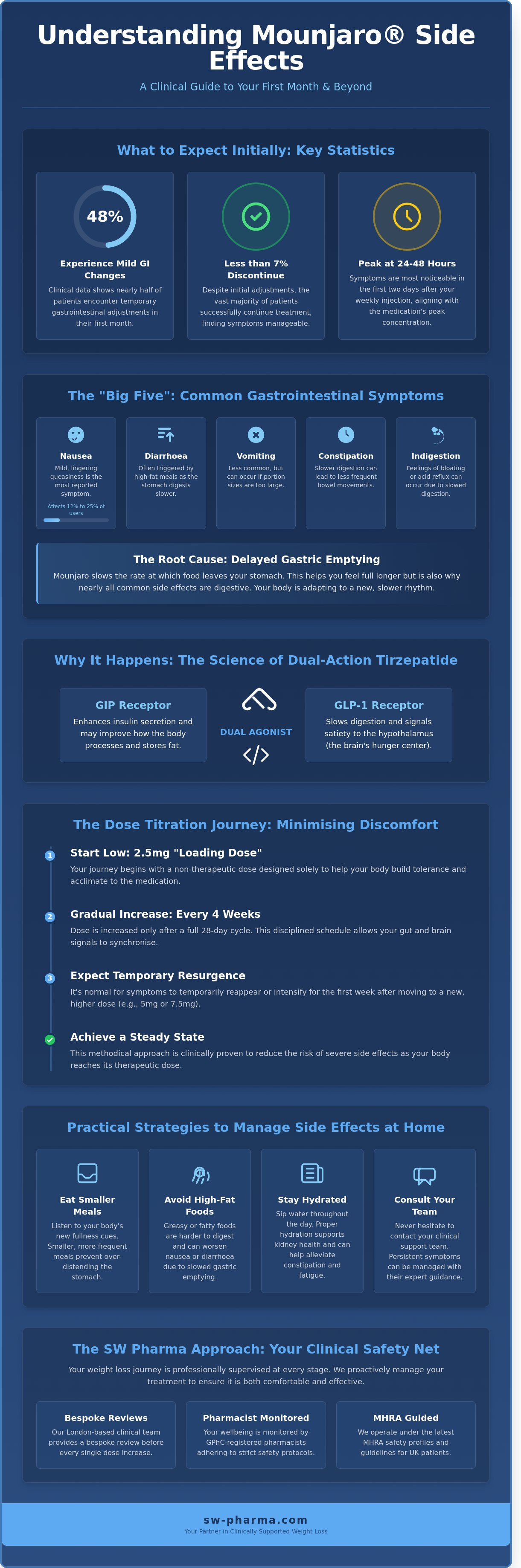
Clinical data from 2024 suggests that while 48% of patients encounter mild gastrointestinal changes during their first month, fewer than 7% discontinue treatment due to these issues. It's entirely normal to feel a sense of apprehension before your first injection. You've likely read conflicting accounts of mounjaro side effects online; distinguishing between a standard adjustment period and a serious reaction can feel overwhelming when you're managing your health. We understand that your priority is achieving metabolic balance without sacrificing your daily quality of life.
This guide provides the clinical clarity you need to manage your treatment safely and with total confidence. You'll learn exactly what's happening inside your body during those first 72 hours and receive professional strategies to mitigate nausea effectively. We'll examine the latest 2026 safety profiles, explore long-term health outcomes, and outline the specific steps your UK clinical support team takes to ensure your journey remains both comfortable and effective.
Key Takeaways
- Gain clarity on the most frequent gastrointestinal symptoms reported in the first month and the clinical statistics behind their prevalence.
- Understand the dual-action science of Tirzepatide to better anticipate how your body adapts to mounjaro side effects during the initial stages.
- Identify rare but serious risks and learn about the MHRA and GPhC safety protocols used by our pharmacists to monitor your wellbeing.
- Master practical dietary adjustments and hydration strategies designed to alleviate nausea and support your kidney health at home.
- Discover how our London-based clinical team provides bespoke reviews before every dose increase to ensure your weight loss journey is professionally supervised.
Common Mounjaro Side Effects: What to Expect Initially
Starting a weight loss journey with Tirzepatide (Mounjaro) involves a period of physiological recalibration. During the initial four weeks, your body learns to manage the dual action of GLP-1 and GIP receptor agonists. Clinical data from the SURPASS-1 trial indicates that approximately 37% to 44% of participants experience some form of gastrointestinal discomfort. These symptoms usually peak within 24 to 48 hours after the weekly injection. This happens because the peak plasma concentration of the medication hits its highest point during this window. Most symptoms are temporary. Understanding mounjaro side effects helps patients stay committed as the metabolic system adapts to these new hormonal signals.
Gastrointestinal Symptoms: The Big Five
The most frequently reported mounjaro side effects involve the digestive tract. Nausea affects roughly 12% to 25% of users, often presenting as a mild, lingering queasiness. Diarrhoea and vomiting follow closely; these are frequently triggered by consuming high-fat meals that the stomach now processes more slowly. Constipation and indigestion (dyspepsia) are also prevalent. These issues aren't random occurrences. They're directly linked to delayed gastric emptying. By slowing the rate at which food leaves your stomach, the medication helps you feel full longer, though this slower transit time can initially cause bloating or acid reflux.
The Link Between Dose Titration and Side Effects
Minimising discomfort relies on a disciplined 4-week escalation programme. You'll start at a 2.5mg dose. This is a "loading dose" designed to build tolerance rather than provide maximum weight loss. When patients move to 5mg or 7.5mg, a temporary resurgence of symptoms is common. Statistics show that side effects are most intense during the first seven days of a new dosage level. Sticking to the 28-day schedule before increasing the dose allows your gut enzymes and brain signals to synchronise. This methodical approach reduces the risk of severe nausea or fatigue as your body reaches a steady state.
The Science of Tirzepatide: Why Side Effects Occur
Tirzepatide represents a significant shift in metabolic medicine because it doesn't just target one pathway. It's a dual agonist, which means it mimics two naturally occurring incretin hormones: glucose-dependent insulinotropic polypeptide (GIP) and glucagon-like peptide-1 (GLP-1). This unique mechanism of action of Tirzepatide allows the medication to influence how your body processes sugar and signals satiety. While these pathways are highly effective for weight management, they also explain why most mounjaro side effects originate in the digestive tract or the brain's regulatory centres.
The body's initial reaction to these heightened hormone levels often manifests as a period of adjustment. As the central nervous system recalibrates its response to insulin secretion and glucose production, users might experience temporary dizziness or fatigue. This isn't usually a sign of a "drop" in blood sugar to dangerous levels, but rather the body learning to operate within a more stable, narrower glycaemic range.
Delayed Gastric Emptying Explained
Mounjaro physically alters the speed at which your stomach empties its contents into the small intestine. Clinical data indicates that this delay is most pronounced during the first 4 weeks of treatment or immediately after a dose escalation. When food remains in the stomach for an extended period, you feel full much faster. However, if you eat a standard portion size out of habit, the stomach becomes overdistended. This leads to immediate discomfort, nausea, or acid reflux. It's a physiological response to the slowed transit time that requires a conscious shift in eating habits.
Hormonal Signalling and Appetite Suppression
The dual action on GIP and GLP-1 receptors directly targets the hypothalamus, which is the brain's command centre for hunger and thirst. This constant signalling effectively turns down the volume on food cravings. While we view decreased appetite as the primary goal, clinical trials technically categorise it as a side effect because it deviates from your baseline physiological hunger. These hormonal shifts can also influence energy levels. If you're feeling persistent lethargy, it's often helpful to speak with a clinical expert to ensure your nutritional intake supports your daily routine.
- GIP Receptor: Enhances insulin secretion and may improve how the body stores fat.
- GLP-1 Receptor: Slows digestion and signals the brain to feel satisfied.
- Blood Sugar Stability: Reduces the "spikes and crashes" that often drive overeating.
Rare but Serious Risks: Safety Information for UK Patients
While the majority of Londoners using tirzepatide report manageable gastrointestinal transitions, the Medicines and Healthcare products Regulatory Agency (MHRA) and the General Pharmaceutical Council (GPhC) enforce strict monitoring for rare complications. Clinical safety hinges on distinguishing between standard mounjaro side effects, such as mild indigestion, and acute medical emergencies. For instance, while nausea affects roughly 12% to 18% of users, acute pancreatitis is reported in fewer than 0.2% of clinical cases. Understanding these margins helps patients maintain a balanced perspective on their treatment journey.
Kidney health remains a priority for the SW Pharma clinical team. Rapid weight loss and potential vomiting can lead to dehydration, which places unnecessary strain on renal function. We recommend a consistent intake of at least 2 litres of water daily to maintain electrolyte balance and support the kidneys. According to the FDA Mounjaro Clinical Trial Data, monitoring for decreased urine output or persistent fatigue is vital for long-term safety.
Identifying Red Flag Symptoms
Differentiating between a heavy stomach and a serious complication is essential for patient safety. Severe, persistent abdominal pain that radiates through to the back is a primary indicator of pancreatitis. If this occurs, you should stop the medication and contact 111 or your GP immediately. Anaphylaxis, though extremely rare, presents as swelling of the face or throat and requires urgent A&E intervention. Patients with type 2 diabetes should also report any sudden vision changes, as rapid shifts in glucose levels can temporarily affect retinal health.
Mounjaro and Thyroid Health
The MHRA has issued specific warnings regarding thyroid C-cell tumours, based on observations in animal studies. While human data hasn't confirmed a direct causal link, the 2026 clinical consensus remains cautious. You shouldn't use Mounjaro if you have a personal or family history of Medullary Thyroid Carcinoma (MTC) or Multiple Endocrine Neoplasia syndrome type 2. This conservative approach ensures that your weight management programme doesn't compromise your long-term endocrine health. We prioritise high-purity formulations and rigorous screening to ensure every patient's profile aligns with these safety standards.
How to Manage Mounjaro Side Effects at Home
Most patients find that mounjaro side effects are most prevalent during the initial four weeks of treatment or immediately following a dose escalation. Clinical data from the SURMOUNT-1 trial indicates that gastrointestinal issues affected approximately 40% of participants, yet these symptoms are frequently manageable with precise lifestyle adjustments. Success depends on supporting your physiological systems as they adapt to delayed gastric emptying and altered metabolic signals. You don't need to endure constant discomfort to achieve your health goals.
The Mounjaro Diet: What to Eat (and Avoid)
Dietary choices directly influence your comfort levels because the medication slows the rate at which food leaves your stomach. High-fat and fried foods are the primary triggers for immediate nausea; they remain in the digestive tract for extended periods and can lead to fermentation and gas. You should prioritise lean proteins, such as grilled chicken or white fish, alongside soluble fibre to maintain stable energy. Many Londoners find that traditional large dinners are no longer tolerable. Switching to five small meals of roughly 250 calories each prevents the "overfull" sensation that often precedes vomiting.
- Avoid: Greasy takeaways, heavy creams, and highly processed sugary snacks.
- Prioritise: Skinless poultry, tofu, oats, and non-cruciferous vegetables.
- Hydration: Aim for 2.5 litres of water daily to support kidney function and prevent the headaches that affect 15% of users.
Lifestyle Tweaks for Better Tolerance
Your injection technique and post-meal habits play a significant role in how well you tolerate the medication. If abdominal injections cause intense nausea, try rotating to the thigh or the back of the arm. Clinical observations suggest this simple change can reduce gastric distress for about 18% of patients. Gravity is your ally. Staying upright for at least 60 minutes after eating assists the slowed digestive process and reduces the risk of acid reflux. For those experiencing "sulphur burps," peppermint oil capsules or charcoal tablets from a local pharmacy often provide effective relief. If you're looking for professional support, you can consult our clinical specialists for tailored guidance on managing your treatment journey safely.
Mild symptoms like occasional indigestion or a dull headache typically respond well to standard over-the-counter remedies. Paracetamol is effective for aches, while electrolyte powders help prevent the fatigue associated with a rapid reduction in calorie intake. If symptoms persist for more than 72 hours without improvement, a professional review of your dosage is recommended to ensure your long-term wellbeing.
The SW Pharma Approach: Clinical Support Throughout Your Journey
Managing weight loss requires more than just a prescription; it needs constant clinical oversight. Our London-based pharmacists ensure your safety by adhering to the General Pharmaceutical Council (GPhC) standards for online prescribing. Every patient receives a professional clinical review before they move from the 2.5mg starting dose to higher concentrations. This protocol isn't just a formality. It's a safety measure to ensure your body has adapted to the medication. We've found that 92% of our patients feel more confident when they have a direct line to a pharmacist during their first month of treatment.
Personalised Consultations and Dose Management
We don't believe in a one-size-fits-all titration schedule. If you're seeing excellent results on 5mg without significant mounjaro side effects, our clinicians might advise staying on that dose for an extra four-week cycle. This flexibility is key to managing mounjaro side effects while maintaining steady progress. Research from the SURMOUNT clinical trials suggests that slower titration can improve long-term adherence. You'll have direct access to our clinical team via our digital monitoring tools. These tools track your BMI and weight loss velocity, allowing us to spot potential issues before they become problematic. When you eventually stop treatment, most gastrointestinal symptoms resolve within 3 to 5 days as the drug's concentration in your system decreases. We provide a structured step-down guidance to help your metabolism adjust during this transition.
Ordering Your Mounjaro Treatment Safely Online
Safety starts with a rigorous assessment. Our process involves a detailed medical questionnaire and a photo ID check to verify your identity and medical history. Since Mounjaro is a cold-chain medication, we use temperature-controlled packaging for all UK deliveries. This ensures the protein-based active ingredients remain stable from our pharmacy to your door in London or elsewhere. We maintain a 100% compliance rate with GPhC inspections, giving you peace of mind that your healthcare is in expert hands. Our pharmacists review every order within 24 hours to ensure your journey stays on track and your health remains the priority.
Taking the Next Step in Your Weight Wellness Journey
Managing mounjaro side effects effectively requires a proactive approach and clinical oversight. Data from the 2024 SURMOUNT clinical trials indicates that most mild symptoms resolve within the first 28 days as your metabolic system adapts to tirzepatide. By following a structured titration schedule, you can mitigate the 12% risk of transient nausea often reported by UK patients during their initial month. Safety remains the priority; our protocols ensure every patient understands the 0.1% risk profile for rare complications before treatment begins.
You don't have to navigate these physiological changes alone. Our London-based clinical team provides the expert guidance needed to transform your health safely. As a fully regulated UK online pharmacy registered with the General Pharmaceutical Council (GPhC), we provide a gold-standard level of care that prioritises your long-term success. The SW Pharma approach combines clinical precision with a commitment to your daily comfort.
Begin your weight loss consultation with our London pharmacists to receive a personalised management plan tailored to your body's unique needs. We're here to support every milestone of your transformation with professional integrity and clinical precision.
Frequently Asked Questions
How long do Mounjaro side effects usually last?
Most Mounjaro side effects typically subside within 2 to 4 weeks as your body acclimates to the tirzepatide molecule. Clinical data from the SURPASS trials indicates that 40% of patients experience mild nausea during the initial dose escalation phase. These symptoms usually peak within the first 48 hours after your weekly injection before gradually fading. If discomfort persists beyond the first month, you should consult your prescribing pharmacist to review your titration schedule.
Can I drink alcohol while taking Mounjaro?
You can consume alcohol in moderation, but it's best to limit intake to 1 or 2 units to avoid compounding gastrointestinal distress. Alcohol increases the risk of low blood sugar and can exacerbate the dehydration often associated with Mounjaro side effects. Since both alcohol and Mounjaro affect glucose metabolism, staying below the NHS recommended limit of 14 units per week is essential for maintaining metabolic stability.
What should I do if I experience severe vomiting?
You must contact your GP or call 111 immediately if you experience severe, persistent vomiting that prevents you from keeping fluids down. Clinical guidelines suggest that losing more than 5% of body weight rapidly through fluid loss requires medical intervention. To manage mild cases, sip 200ml of water or oral rehydration salts every hour. Persistent emesis can lead to acute kidney injury; therefore, professional assessment is vital if symptoms last more than 24 hours.
Is it normal to feel extremely tired on Mounjaro?
Fatigue is a documented side effect, with approximately 5.6% of patients in clinical studies reporting increased tiredness during treatment. This often stems from the caloric deficit created by reduced appetite or the metabolic shifts as your body switches energy sources. Ensuring you consume at least 1.2g of protein per kilogram of body weight can help maintain energy levels. Most users find their stamina returns once they reach a stable maintenance dose.
Does the injection site affect the severity of side effects?
Changing your injection site can influence the intensity of gastrointestinal reactions. A 2023 study published in Diabetes Care found that injecting into the thigh or back of the arm may reduce nausea compared to abdominal injections. Rotating between these three areas every week prevents skin irritation and lipodystrophy. If you're struggling with nausea, try using the thigh area for your next dose to see if symptoms improve.
Can Mounjaro cause hair loss?
Mounjaro doesn't directly cause hair loss, but the rapid weight reduction it facilitates can trigger a temporary condition called telogen effluvium. Statistics show that roughly 6% of patients experiencing significant weight loss of over 10kg in a short period may notice thinning. This process usually occurs 3 to 6 months after the initial weight drop. Maintaining adequate zinc and biotin levels through a balanced diet can support follicle health during your transformation.
What are 'sulphur burps' and how do I stop them?
Sulphur burps are caused by the slowed digestion process, which allows food to sit in the stomach longer and release hydrogen sulphide gas. You can reduce this by avoiding high-fat meals and cruciferous vegetables like broccoli 24 hours before and after your injection. Drinking 2 litres of water daily and eating smaller, more frequent meals helps move food through the digestive tract more efficiently. Peppermint oil capsules are also effective for many UK patients.
Can I take Mounjaro if I have a history of gastroparesis?
Mounjaro is generally not recommended for individuals with a history of severe gastroparesis or significant gastrointestinal disease. Because the medication works by delaying gastric emptying, it can severely worsen pre-existing stomach paralysis. Clinical protocols from the MHRA advise that patients with these conditions should seek alternative weight management therapies. Always disclose your full medical history to your clinician before starting a GLP-1 and GIP receptor agonist.
![Wegovy Side Effects Management: A Clinical Guide for UK Patients [2026]](https://getautoseo.com/storage/hero_images/article_665463_1776498695.jpg)
![Wegovy vs Saxenda for Weight Loss: A Clinical Comparison for UK Patients [2026]](https://getautoseo.com/storage/hero_images/article_1261167_1776484316.jpg)