

What if your weight loss plateau isn't a sign of a "broken" metabolism, but simply a minor data gap in your energy balance equation? In 2026, clinical research indicates that 85 percent of individuals struggle with weight management because they rely on generic estimates rather than using a professional calorie calculator to track precise physiological data. You've likely felt the deep frustration of seeing progress stall after exactly three weeks, leading to valid concerns about metabolic damage or the myth of starvation mode. It's difficult to maintain motivation when your body's biological response doesn't seem to match your hard work.
This article provides the professional clarity you need to regain control of your journey. You'll learn the clinical science behind energy balance and how to use these digital tools as precision instruments for your long-term health. We'll demystify the relationship between your Basal Metabolic Rate and your Total Daily Energy Expenditure to remove the guesswork from your routine. By the end, you'll have a calculated daily target and a clear understanding of when to seek medical support to ensure your weight management remains both safe and scientifically sound.
Key Takeaways
- Gain a professional understanding of the science of energy balance and how it serves as the foundation for all sustainable weight management.
- Learn how to use a calorie calculator to accurately determine your BMR and TDEE, ensuring your nutrition plan is tailored to your unique biological needs.
- Discover why traditional "calories in vs. calories out" math can fail due to metabolic adaptation and how to navigate these physiological plateaus.
- Master the practical application of your results by setting a sustainable 500-calorie deficit while prioritizing protein to preserve vital lean muscle mass.
- Identify the clinical indicators that suggest a need for medical intervention when biological factors require more than standard lifestyle adjustments.
Understanding the Calorie Calculator: The Science of Energy Balance
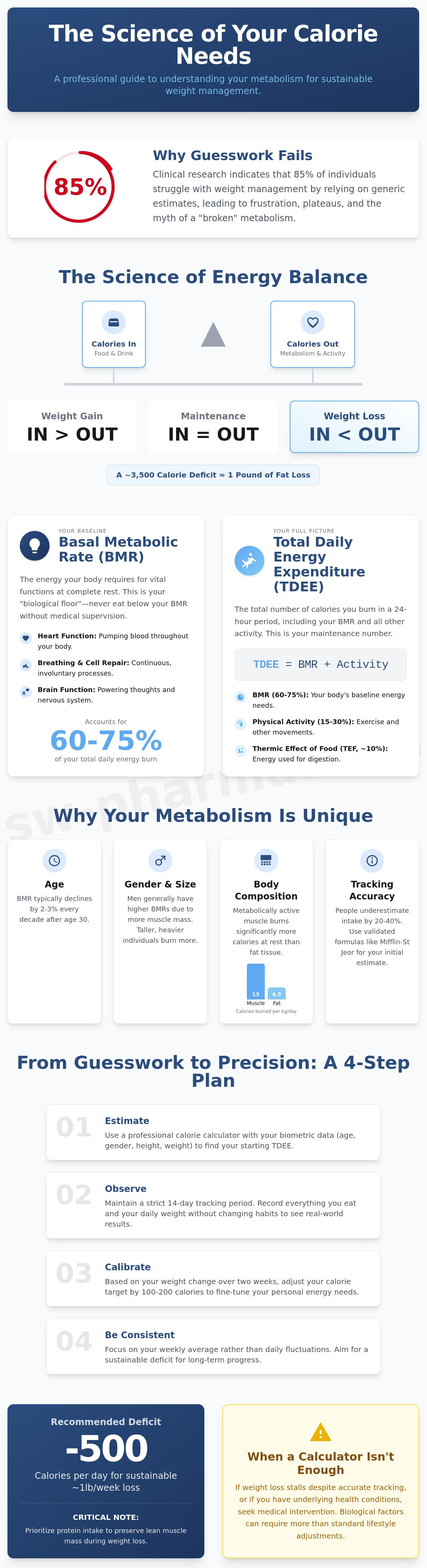
Sustainable weight management relies on a fundamental principle of thermodynamics rather than temporary trends. At its core, The Science of Energy Balance defines the relationship between the energy you ingest through food and the energy your body utilizes to maintain life. A calorie isn't a physical object; it's a unit of heat energy required to raise the temperature of one gram of water by one degree Celsius. Your body constantly demands this energy to fuel involuntary functions like cellular repair and heart rhythm, as well as voluntary physical movement.
A calorie calculator serves as a clinical tool to estimate these needs by processing biometric variables. Weight loss occurs only when a consistent energy deficit is maintained. This means consuming fewer calories than the body expends over a sustained period. When this deficit reaches approximately 3,500 calories, the body typically metabolizes one pound of stored adipose tissue to bridge the energy gap. Accuracy in this initial calculation prevents the metabolic adaptation that often stalls progress.
Why One Size Does Not Fit All
Individual energy requirements vary significantly based on biological markers. A 25 year old male standing 185 cm tall will have a vastly different baseline than a 55 year old female at 160 cm, even if they share the same weight. Age is a critical factor, as basal metabolic rate (BMR) typically declines by 2% to 3% every decade after age 30. Body composition also dictates expenditure; muscle tissue is metabolically active and burns approximately 13 calories per kilogram per day at rest, while fat tissue burns only about 4.5 calories. The Thermogenic Effect of Food represents the specific energy requirement your body uses to digest, absorb, and process nutrients from the meals you consume.
The Role of Accuracy in Tracking
Precision is the bridge between scientific theory and visible results. Research indicates that individuals often underestimate their caloric intake by 20% to 40% due to hidden fats and portion size errors. For example, a single tablespoon of olive oil added to a pan contributes 120 calories that frequently go unrecorded. To mitigate these errors, it's vital to use a calorie calculator based on validated formulas like Mifflin-St Jeor, which has been shown in clinical studies to be more accurate for modern populations than the older Harris-Benedict equation.
- Initial Estimate: Use your biometric data to find a starting point.
- Observation: Maintain a strict 14-day tracking period without changing habits.
- Calibration: Adjust your target by 100-200 calories based on real-world weight changes during those two weeks.
- Consistency: Focus on the weekly average rather than daily fluctuations.
Relying on a calculated target provides a baseline, but the 14-day observation period remains the gold standard for personal calibration. This methodical approach ensures that your weight loss journey is built on data rather than guesswork, fostering long-term health and metabolic stability.
BMR vs TDEE: Deciphering the Acronyms of Weight Loss
Successful weight management relies on clinical precision rather than guesswork. To get the most out of a calorie calculator, you must first distinguish between your body's internal maintenance requirements and its external energy demands. These two figures create the boundary lines for a safe, sustainable caloric deficit that protects your metabolic health.
Calculating Your Basal Metabolic Rate
Your Basal Metabolic Rate (BMR) represents the energy your body requires to maintain basic physiological functions while at complete rest. This includes vital processes like heart function, continuous breathing, and internal temperature regulation. In a typical adult, BMR accounts for 60% to 75% of total daily energy expenditure. It's the biological "floor" for your nutritional intake. You should never consume significantly fewer calories than your BMR without direct medical supervision. Dropping below this threshold can lead to muscle wasting and hormonal imbalances. A scientifically grounded supplement regimen can support your metabolism, but it cannot replace the essential energy your organs need to function.
Factoring in Physical Activity Levels
Total Daily Energy Expenditure (TDEE) is the sum of your BMR plus the energy used for digestion and physical movement. Accuracy is vital here because 80% of people overestimate their activity levels, which leads to a weight loss plateau. To avoid this, you must categorize your lifestyle into specific tiers:
- Sedentary: Desk jobs with little to no intentional exercise.
- Lightly Active: Light exercise or walking 1 to 3 days per week.
- Moderately Active: Moderate exercise or sports 3 to 5 days per week.
- Very Active: Hard exercise or physical labor 6 to 7 days per week.
It's vital to distinguish between "exercise" and Non-Exercise Activity Thermogenesis (NEAT). NEAT includes walking to your car, cleaning, or standing at a desk. These small movements often contribute more to your TDEE than a single 45-minute gym session. When using a calorie calculator, choosing a lower activity multiplier is usually the safer path to ensure a consistent deficit. To refine these estimates with clinical data, the NIH Body Weight Planner offers a validated framework for predicting how specific activity changes will alter your body composition over a set period. Understanding these numbers transforms weight loss from a trial-and-error process into a predictable biological equation.
Why the Math Sometimes Fails: Biology vs. The Calculator
Many individuals reach a point where the scale refuses to budge despite following a strict 500-calorie deficit. This phenomenon occurs because a calorie calculator provides a static estimate for a dynamic biological system. Your body doesn't view weight loss as a cosmetic goal; it perceives it as a threat to survival, triggering protective mechanisms that mathematical formulas can't predict. While the math of thermodynamics remains constant, the variables within your body are constantly shifting.
Metabolic Adaptation and Plateaus
As you lose weight, your energy requirements naturally decrease because there's less tissue to maintain. However, clinical research indicates that a 10% reduction in body mass can lead to a disproportionate 15% to 20% drop in metabolic rate. This shift in how you burn calories means your initial targets must be adjusted every 4 to 6 weeks to remain effective. A true plateau is defined as a lack of progress for 21 consecutive days. Short-term fluctuations are often just water retention caused by increased cortisol or glycogen replenishment.
- Adaptive Thermogenesis: The body becomes more efficient, requiring fewer calories for the same physical movements.
- Starvation Response: Extreme deficits, typically those below 1,200 calories for women or 1,500 for men, can cause the body to downregulate non-essential functions like thermoregulation.
- Muscle Loss: Rapid weight loss often sacrifices lean mass. Since muscle is metabolically active, losing it lowers your resting metabolic rate significantly.
The Hormonal Hurdle
Hormones dictate the "why" behind eating behaviors. Clinical data shows that weight loss increases ghrelin, the hunger hormone, and decreases leptin, the satiety hormone. This biological drive to eat can become so intense that it overrides conscious willpower. For patients with insulin resistance, high circulating insulin levels act as a metabolic lock. This prevents the body from accessing fat stores even when the calorie calculator suggests loss should occur.
Chronic stress increases cortisol, which promotes visceral fat storage and masks fat loss through fluid retention. When lifestyle adjustments and precise tracking fail to produce results for 30 days, the focus should shift from "eating less" to clinical intervention. Addressing underlying thyroid issues or hormonal imbalances is often the missing link in achieving sustainable results. We recommend consulting a specialist if your progress remains stagnant despite 90% adherence to your nutritional targets for a month.
How to Implement Your Results for Sustainable Progress
Once your calorie calculator results define your Total Daily Energy Expenditure (TDEE), the implementation phase begins. This stage requires a clinical approach to ensure fat loss doesn't compromise your physiological health. A standard deficit of 500 calories per day creates the necessary energy gap for a steady, 0.5kg weekly reduction in body mass. You must maintain this specific deficit for at least 4 weeks before making any adjustments. This duration allows your body to bypass initial water weight shifts and reveal true fat loss trends through consistent data.
Sustainable progress relies on preserving lean tissue. You should prioritize a high protein intake, ideally between 1.6 and 2.2 grams per kilogram of body weight. This strategy protects muscle fibers while you're in a catabolic state. Don't focus solely on the numbers; the bioavailability of your nutrients determines your long-term success. High-quality micronutrients from whole foods support the enzymatic processes required for efficient fat oxidation and keep satiety levels high.
Setting Your Daily Targets
Aim for a weight loss rate of 0.5kg to 1kg per week. Rates exceeding this often lead to muscle wasting and metabolic adaptation. Distribute your energy intake across three to four consistent meals to maintain stable blood glucose levels. Avoid the "cheat day" mentality. A single day of excessive caloric intake can easily neutralize a 2,500-calorie weekly deficit, stalling your progress entirely. Consistency is the primary driver of metabolic efficiency.
Monitoring and Adjusting
Your body is a dynamic system. Use a weight trend app to track a 7-day moving average, as daily fluctuations of 1.5kg are common due to glycogen and water shifts. Revisit the calorie calculator every time you lose 5kg of body weight. Smaller bodies require less energy to function; therefore, your targets must evolve with your new physical profile. Watch for physiological red flags. Chronic fatigue, significant hair thinning, or persistent irritability suggest your deficit is too aggressive. These symptoms often appear when energy availability drops below 30 kcal per kg of fat-free mass, signaling a need for immediate caloric adjustment.
When a Calorie Calculator Isn’t Enough: The Clinical Path
Mathematical precision has its limits. While a calorie calculator provides a vital baseline for energy balance, it cannot account for the complex hormonal feedback loops that govern hunger and metabolic rate. For many individuals, biological resistance makes the "eat less, move more" mantra ineffective. Biology often overrides willpower. Research published in 2023 suggests that metabolic adaptation can reduce an individual's daily energy expenditure by 10% to 15% beyond what standard formulas predict. This makes weight loss plateaus a biological reality rather than a failure of discipline.
Clinical Weight Loss Solutions
Medical science now offers pathways to bypass these biological hurdles. GLP-1 receptor agonists, such as Mounjaro and Wegovy, have redefined chronic weight management. These medications work by mimicking incretin hormones that regulate appetite centers in the brain and slow gastric emptying. Clinical data from the STEP trials showed that participants using semaglutide lost an average of 14.9% of their body weight over 68 weeks, compared to just 2.4% in the placebo group. These treatments create a metabolic environment where the targets set by your calorie calculator become achievable. They address the physiological "food noise" that often leads to caloric surplus, allowing for a sustainable, controlled intake without the constant struggle against hunger.
Your Journey with SW Pharma
SW Pharma prioritizes clinical safety and professional oversight. We believe that medication is most effective when integrated into a structured, medically supervised plan. Our licensed pharmacists evaluate your health history to determine if pharmacological support is the right step for your biology. We move you beyond the initial calculation phase into a comprehensive clinical review. This transition ensures that your weight loss strategy is both safe and scientifically sound. If your progress has stalled despite meticulous tracking, it's time to consider a professional medical perspective. We provide the expertise needed to navigate these advanced treatments safely.
Ready to move beyond the numbers? Start your clinical consultation with SW Pharma today to explore a medical path tailored to your unique physiology.
Achieve Your Health Goals Through Clinical Precision
A calorie calculator provides a necessary baseline, yet it's only the beginning of your metabolic journey. Clinical data shows that standard formulas can vary by up to 20% based on individual hormonal health and gut microbiome diversity. Success in 2026 requires moving beyond simple math and monitoring your body's specific response over a consistent 30 day period. When the gap between your efforts and your results persists, it's often a sign that underlying biology requires a medical perspective.
At SW Pharma, we bridge the gap between digital tracking and biological reality. We're fully registered with the General Pharmaceutical Council (GPhC), ensuring your care meets the highest UK safety standards. Our licensed pharmacists offer expert consultations to help you access clinically proven treatments like Mounjaro and Wegovy. These medications have demonstrated weight loss results of 15% to 22% in clinical trials. You don't have to navigate these complex physiological hurdles alone.
Begin your professional weight loss assessment
Your path to a healthier life is a long term commitment, and the right professional support makes every step more effective.
Frequently Asked Questions
Is a calorie calculator 100% accurate for everyone?
A calorie calculator provides a statistical estimate rather than an absolute measurement of your unique metabolic rate. Most validated formulas, such as the Mifflin-St Jeor equation, maintain a 10% margin of error because they can't account for individual variations in muscle density or hormonal health. You should treat the initial number as a scientific baseline. Track your progress for 21 days and adjust your intake based on your real-world physiological responses.
How many calories should I eat to lose 1lb or 0.5kg a week?
You need to create a cumulative weekly deficit of 3,500 calories to lose 1lb of body fat. This typically requires consuming 500 calories fewer than your Total Daily Energy Expenditure (TDEE) every day. If your maintenance level is 2,200 calories, aim for 1,700 calories to reach your goal. Sustainable progress relies on this mathematical balance between energy intake and metabolic output to ensure long-term health.
What is the minimum amount of calories a woman or man should eat?
Medical guidelines establish a daily floor of 1,200 calories for women and 1,500 calories for men to ensure adequate micronutrient intake. Dropping below these thresholds risks metabolic adaptation and muscle wasting. If you consume less than these amounts, your body struggles to maintain vital functions like hormone production and immune response. Consult a clinical nutritionist if your calculated requirements fall below these safety limits to avoid nutritional deficiencies.
Can I lose weight without counting every single calorie?
You can achieve weight loss by focusing on nutrient density and portion control without logging every gram of food. Research indicates that 80% of successful weight management stems from consistent dietary habits rather than perfect tracking accuracy. Using methods like the plate rule, where 50% of your meal consists of fibrous vegetables, naturally creates a deficit. It's about prioritizing biological satiety and high-quality ingredients rather than just mathematics.
Why has my weight loss stopped even though I am following the calculator?
Weight loss plateaus often occur because your metabolism becomes more efficient as your body mass decreases. Your Basal Metabolic Rate drops by approximately 15 to 20 calories for every kilogram of weight you lose. If your progress stalls for more than 21 days, you must recalculate your needs. Small errors in portion estimation or changes in non-exercise activity levels can also eliminate a previously successful deficit during your journey.
How does exercise affect my calorie calculator results?
Exercise increases your Total Daily Energy Expenditure (TDEE) by raising the activity multiplier used in the calculation. A 30 minute session of vigorous resistance training can burn between 200 and 400 calories depending on your current mass. While the calorie calculator accounts for this, you shouldn't use exercise as a justification for excessive caloric intake. Physical activity serves primarily to preserve lean muscle mass and optimize metabolic health during a weight loss phase.
What is the difference between BMR and TDEE?
BMR represents the energy your body requires at complete rest to maintain vital organ function, while TDEE includes all physical movement and digestion. For most adults, BMR accounts for 60% to 75% of total daily energy expenditure. Your TDEE is the more relevant number for weight loss because it reflects your actual lifestyle and activity levels. Understanding this distinction helps you set realistic goals based on both your biology and your daily movement.
Should I eat back the calories I burn during exercise?
You should avoid eating back all exercise calories because most tracking devices overestimate energy expenditure by 25% to 40%. If you feel excessively fatigued, consider consuming only 50% of those burned calories to maintain your recovery and energy levels. This conservative approach ensures you don't accidentally erase your deficit. Precision in nutrition is more reliable than the fluctuating data provided by wearable technology during a typical workout session.
![Wegovy Side Effects Management: A Clinical Guide for UK Patients [2026]](https://getautoseo.com/storage/hero_images/article_665463_1776498695.jpg)
![Wegovy vs Saxenda for Weight Loss: A Clinical Comparison for UK Patients [2026]](https://getautoseo.com/storage/hero_images/article_1261167_1776484316.jpg)