

What if the most critical factor in your hair restoration journey isn't the medication itself, but the specific date on your calendar? It's natural to feel a sense of urgency when you notice thinning at the crown or a receding hairline, and checking the mirror every morning for progress is an experience shared by thousands of men across the UK. You likely want to know exactly how long does finasteride take to work before you can decide if the treatment is effective for your specific physiology.
Patience is often the most difficult part of clinical recovery, especially when biological processes move at a slower pace than our daily expectations. This guide provides a detailed breakdown of the 12-month timeline, moving past the anxiety of initial shedding phases to the reality of visible regrowth. We'll examine the physiological milestones from the first 24 hours of DHT suppression to the peak density often achieved after 365 days of consistent use, helping you stay motivated through every stage of the process.
Key Takeaways
- Learn why your scalp's DHT levels drop by 70% within the first 24 hours, even though visible changes to hair density require several months of clinical patience.
- Understand exactly how long does finasteride take to work by following a detailed 12-month roadmap that tracks your progress from stabilisation to active regrowth.
- Discover why the "finasteride shed" is actually a positive biological indicator that your follicles are successfully transitioning into a new, healthier growth phase.
- Explore how the natural cycles of hair growth dictate your results and why consistent daily application is the only way to overcome these biological barriers.
- Identify the synergistic lifestyle factors and supplemental treatments that can enhance the efficacy of your protocol for optimal long-term hair health.
Understanding the Finasteride Timeline: Immediate Action vs. Visible Results
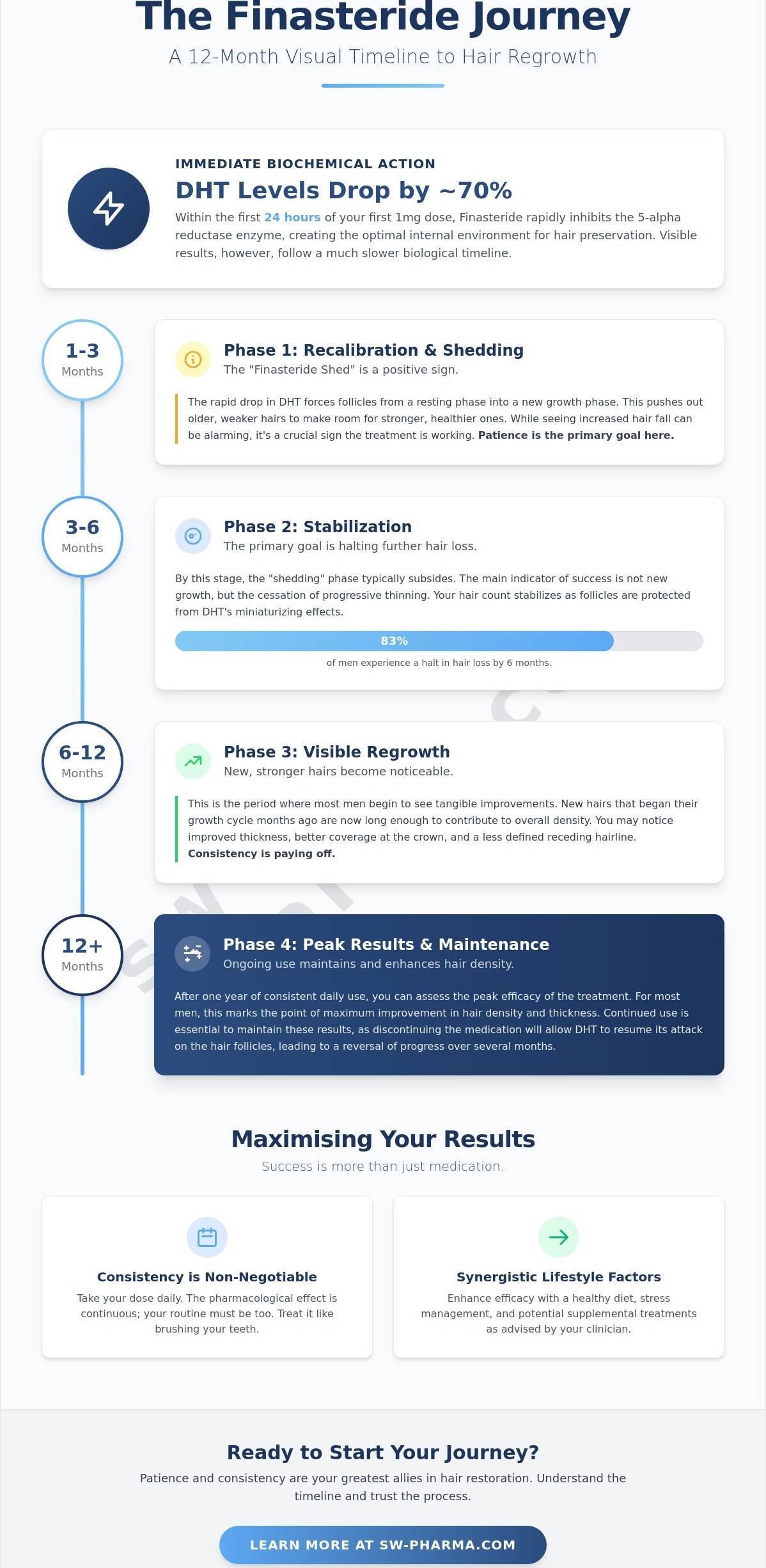
Finasteride belongs to a class of medications known as 5-alpha reductase inhibitors. Its primary function is to intercept the enzyme responsible for converting testosterone into dihydrotestosterone (DHT). When men ask how long does finasteride take to work, they must distinguish between systemic absorption and follicular recovery. Internally, the drug is exceptionally fast. Clinical studies confirm that serum DHT levels drop by up to 70% within just 24 hours of the first 1mg dose. This rapid biochemical shift creates the necessary environment for hair preservation, yet the scalp requires significantly more time to reflect these changes.
The discrepancy between blood chemistry and visible hair density exists because hair is a slow-growing biological tissue. On average, human hair grows at a rate of 1cm per month. Because the medication targets the follicle at the root, any new, healthier growth must travel through the scalp before it becomes visible to the eye. You're essentially waiting for a biological lag to catch up with the pharmacological intervention. This is why the initial phase of treatment requires clinical patience rather than immediate expectation.
The Role of DHT in Hair Loss
In men with a genetic predisposition to male pattern baldness, DHT binds to androgen receptors in the scalp. This triggers a process called miniaturisation. The hormone effectively chokes the hair follicle, causing it to produce increasingly thinner, shorter, and less pigmented strands. Eventually, the follicle becomes too weak to produce a visible hair at all. Finasteride works by halting this hormonal attack. Stopping the progressive damage is the vital first step; regrowth cannot occur until the follicle is no longer under constant chemical stress.
Why Your Hair is a "Lagging Indicator"
Understanding how long does finasteride take to work requires a shift in perspective. Think of your scalp as a garden. If you improve the nutrient quality of the soil today, you won't see a new flower by tomorrow morning. The soil (your hormonal environment) has changed, but the plant (your hair) must still complete its natural growth cycle. Physical results are a lagging indicator of the success happening internally. Most clinicians advise that you shouldn't judge the efficacy of the treatment within the first 90 days. During this initial window, your body is simply stabilising the follicles and preparing for the next growth phase. Patience is a clinical requirement when managing hair health.
Month-by-Month: What to Expect During Your First Year of Finasteride
Understanding how long does finasteride take to work requires a shift in perspective from immediate gratification to clinical patience. The biological process of hair growth is inherently slow; a single follicle typically grows only 1cm per month. Because the medication works by altering the hormonal environment surrounding these follicles, the visible changes occur in cycles rather than overnight.
The First 90 Days: Survival Mode
During the first three months, your body undergoes a period of internal recalibration. Finasteride begins to inhibit the 5-alpha reductase enzyme almost immediately, which reduces serum DHT levels by approximately 70%. This rapid hormonal shift often triggers a temporary "shedding" phase. While it feels alarming to see more hair in the shower, this is a positive clinical sign. The medication is forcing follicles in the resting phase to transition into a new growth phase, pushing out old, weak hairs to make room for stronger ones.
This period represents the highest "quit rate" for patients. The lack of visible growth, combined with temporary shedding, creates a psychological hurdle. To maintain consistency, it is helpful to treat your daily dose as a non-negotiable part of your morning routine, much like brushing your teeth. Success in these first 90 days is measured by persistence rather than aesthetics.
The Six-Month Milestone: Stopping the Bleed
By the six-month mark, the primary objective is "hair loss arrest." For many men, the most significant indicator of success is not the presence of new hair, but the absence of further loss. Clinical data suggests that over 80% of men experience a cessation of hair loss within this window. You may notice that the hair you do have feels slightly thicker or more resilient.
It is vital to avoid the "mirror trap," where daily inspections make it impossible to see gradual progress. Instead, compare your hair to high-resolution baseline photos taken on the day you started treatment. If your hairline and crown look identical to your day-one photos, the medication is working effectively. Preventing further recession is the foundation upon which future regrowth is built.
One Year and Beyond: Long-Term Management
The 12-month milestone is typically when density and texture improvements become visible to the naked eye. The fine, "peach fuzz" hairs that may have appeared around month nine often transition into thicker, pigmented terminal hairs by the one-year mark. However, the process doesn't peak here; clinical trials show that hair count and scalp coverage can continue to improve for up to 24 months of continuous use.
Finasteride is a long-term commitment to your follicular health. If you stop the treatment, the protective barrier against DHT vanishes. The miniaturisation process will resume, and any hair saved or regrown is typically lost within 6 to 12 months of cessation. To ensure you maintain your progress, it is wise to secure a consistent supply of high-quality treatments through a trusted provider. Consistency is the only way to protect the investment you have made in your hair over the past year.
The Biological Barrier: Why Hair Growth Cycles Dictate Your Progress
The speed of your results isn't just about the medication's potency. It's governed by the rigid biological clock of your hair follicles. Understanding how long does finasteride take to work requires a closer look at the scalp's natural rhythm. Finasteride doesn't create new follicles; it repairs and protects existing ones. However, it can only exert its influence during specific windows of the hair's life cycle. If you don't see immediate changes, it's often because your follicles are simply following their internal schedule.
Anagen, Catagen, and Telogen Explained
Every hair on your head is at a different stage of a three-part cycle. The Anagen phase is the active growth period, typically lasting between two and seven years. This is followed by Catagen, a brief transition stage of about ten days. Finally, the Telogen phase is a resting period lasting approximately 90 to 100 days. In a healthy scalp, about 85% to 90% of hairs are in the growth phase at any given time.
DHT disrupts this balance by aggressively shortening the Anagen phase. This forces hairs to enter the resting phase much sooner than they should. When you start treatment, finasteride begins lowering DHT levels in the scalp by up to 60% within 24 hours. Despite this rapid chemical change, follicles stuck in the Telogen phase cannot immediately produce new growth. They must finish their three-month rest before they can transition back into Anagen. This biological "reset" period is the primary reason why most users see very little change in the first 90 days of their journey.
The Miniaturisation Reversal Process
Male pattern baldness is defined by miniaturisation. This is a process where follicles gradually shrink, producing thinner and shorter hairs until they eventually stop producing visible hair altogether. Reversing this damage is a multi-stage recovery. It's not a single event but a series of improvements over successive growth cycles. This slow progression is a key factor in how long does finasteride take to work for visible density.
- The First Cycle: The follicle begins to recover from DHT suppression. The first hairs produced are often "vellus-like," meaning they're thin, light, and almost translucent.
- The Second Cycle: As the follicle's health improves and its diameter expands, the hair becomes sturdier. This usually occurs between months six and nine.
- The Third Cycle: After a full year of consistent use, the follicle often reaches its maximum potential diameter, resulting in thicker, more pigmented strands.
Because these cycles are long, the visual density of your hair improves slowly. It's a cumulative process where each healthy cycle builds upon the last. This is why clinical studies often use 12 months as the primary benchmark for assessing a patient's response. Patience is a clinical requirement, as the body needs time to physically rebuild the structures that DHT spent years breaking down.
The Finasteride Shed: Why Losing Hair Initially is a Sign of Success
It's the most common concern for men starting treatment: "I'm losing more hair than when I started." This phenomenon, often called paradoxical shedding, is actually a clinical indicator that the medication is altering your hair growth cycle for the better. While it feels counterintuitive, this temporary loss is a necessary step in the transition from thinning patches to a fuller head of hair. It isn't a sign of treatment failure; it's a sign of biological renewal.
Understanding how long does finasteride take to work requires accepting this initial phase. Clinical observations suggest that approximately 15% to 20% of men experience a noticeable shed within the first 2 to 8 weeks of treatment. This isn't progressive male pattern baldness accelerating. Instead, it's the synchronisation of your hair follicles as they respond to the reduction of Dihydrotestosterone (DHT) levels in the scalp. When DHT levels drop, the follicles are finally able to exit their dormant state.
Clearing the Way for Stronger Strands
Finasteride works by shifting follicles from the telogen (resting) phase into the anagen (growth) phase. When a follicle enters a new growth cycle, it must eject the old, miniaturised hair to make room for a new, thicker strand. This "clearing out" process is a positive clinical marker. You're essentially trading weak, translucent hairs that were destined to fall out anyway for terminal hairs that have better structural integrity and pigmentation. Without this shed, the follicle remains blocked by a dying, thin hair that lacks the vitality required for a dense hairline.
How to Manage the Shedding Phase
Managing this period requires patience and a focus on scalp health. You can support your transition by following these evidence-based steps:
- Maintain a consistent daily routine without skipping doses to keep DHT levels stable.
- Use a gentle, pH-balanced shampoo to reduce scalp inflammation and provide a healthy environment for new growth.
- Avoid aggressive heat styling or chemical treatments during the first 90 days of treatment.
If shedding persists beyond 4 months, or if you notice patchy loss rather than diffuse thinning, consult a pharmacist or clinician. The greatest risk during this phase is stopping treatment prematurely. Quitting during a shed means you've lost the old hair without giving the new, stronger hair the time it needs to emerge. Consistency is the only way to see the full benefits of the 12-month timeline and understand how long does finasteride take to work for your specific physiology.
Achieve your hair restoration goals with professional support and explore our range of clinically proven treatments.
Maximising Your Results: How to Get the Most from Your Treatment
Understanding how long does finasteride take to work is only half the battle. To achieve the best possible hair density by 2026, you need a structured clinical strategy. While the medication performs the heavy lifting by suppressing DHT, your lifestyle and supplementary habits dictate the ceiling of your success. Consistency isn't just about taking a pill; it's about creating an environment where follicles can thrive.
Combination Therapy: The "Gold Standard"
Clinical data suggests that combining Finasteride with Minoxidil yields superior results compared to using either alone. Finasteride addresses the internal hormonal cause of hair loss by blocking the conversion of testosterone into DHT. Minoxidil acts as a vasodilator, widening blood vessels to deliver more oxygen and nutrients to the follicle. This dual-action approach is often called the "Gold Standard" in hair restoration. For a deeper dive into the science, read our Finasteride for Hair Loss: A Clinical Guide. Treating the issue from two different biological angles creates a synergistic effect that results in faster, more resilient growth and improved hair shaft diameter.
Tracking Your Progress Like a Pro
Visual changes occur slowly. You won't notice daily shifts, so a "monthly photo" protocol is essential for your 2026 treatment plan. Follow these steps for accurate tracking:
- Consistent Lighting: Use the same room and time of day to avoid shadows that mimic thinning.
- Specific Angles: Take top-down shots of the vertex (crown) and clear shots of the temples.
- Hair Length: Try to keep your hair at a similar length in photos for a fair comparison.
The vertex often shows regrowth earlier than the hairline due to different follicle sensitivities. Consistency in your tracking allows you to review progress during clinical consultations with a safe online pharmacy London. These regular reviews ensure your dosage remains effective and your scalp health stays optimal throughout the year.
Lifestyle Factors and Clinical Oversight
Your body needs the right raw materials to build new hair. A diet rich in zinc, biotin, and iron supports the keratin production process. Conversely, smoking restricts blood flow to the scalp, which can directly hinder the effectiveness of your treatment. Managing stress is equally vital. High cortisol levels can trigger temporary shedding, which might lead you to believe the medication isn't working when it actually is.
The SW Pharma Approach to Men’s Health
At SW Pharma, we provide more than just prescriptions. Our UK-licensed pharmacists offer discreet, professional consultations to help you navigate your journey. We operate under strict GPhC registration, ensuring every tablet you receive is authentic and meets UK safety standards. Professional guidance helps manage expectations about how long does finasteride take to work for your specific hair profile. If you're ready to take control of your hair health with a clinically-backed plan, start your assessment today. Our experts will guide you through every stage of the 12-month timeline with precision and care.
Commit to Your Hair's Long-Term Restoration
Understanding how long does finasteride take to work is the first step toward regaining your confidence. Clinical data shows that while DHT levels drop within 24 hours, visible hair density changes typically require 3 to 6 months of daily use. Don't be discouraged by the initial shedding phase. It's a physiological signal that new, stronger strands are pushing out older ones. By the 12-month mark, approximately 90% of men experience either hair regrowth or a significant halt in their hair loss. Consistency remains your most powerful tool in this biological process.
SW Pharma provides the medical oversight and clinically proven hair loss solutions you need for a successful journey. As a GPhC Registered Pharmacy, we offer discreet UK home delivery to ensure your treatment remains private and professional. Your progress depends on starting with a reliable foundation and sticking to the timeline. Take the first step toward a fuller head of hair with expert support.
Begin your clinical assessment for Finasteride today
Frequently Asked Questions
Is finasteride results permanent if I stop taking it?
No, the benefits of finasteride aren't permanent and will reverse if you discontinue the medication. Finasteride requires continuous daily use to maintain the suppression of dihydrotestosterone (DHT) in the scalp. Clinical observations show that any hair gained or maintained during treatment will typically shed within 6 to 12 months after your last dose. Once the active compound is cleared from your system, the genetic miniaturisation process resumes its original pace.
Can I speed up my finasteride results with vitamins?
Vitamins won't accelerate the pharmacological mechanism of finasteride, but they support the structural integrity of new hair growth. While finasteride targets the hormonal cause of thinning, nutrients like biotin, zinc, and iron provide the essential building blocks for keratin production. A 2019 study suggests that nutritional deficiencies can hinder the hair's growth cycle, so maintaining optimal levels ensures your follicles function at their peak capacity during treatment.
Will finasteride work for a completely bald scalp?
Finasteride is generally ineffective on areas of the scalp where follicles have completely atrophied and been replaced by scar tissue. The medication works by revitalising miniaturised follicles that are still active and producing fine hairs. If a scalp area has been completely smooth for several years, the likelihood of regrowth is low. Clinical data indicates that the best results occur in men with mild to moderate thinning rather than total hair loss.
What should I do if I don’t see results after 6 months?
You should continue the treatment for at least 12 months before assessing its total efficacy. While some users see changes earlier, many clinical trials demonstrate that peak hair count improvements often occur between the 12 and 24 month marks. If you're concerned about how long does finasteride take to work, consult your GP or a specialist to ensure there aren't underlying conditions like thyroid dysfunction or iron deficiency affecting your progress.
Does finasteride work better on the crown or the hairline?
Clinical evidence shows that finasteride is most effective at promoting regrowth in the vertex, or crown, area of the scalp. In a landmark five year study, 48 percent of men showed visible regrowth in the crown, while results at the hairline were more focused on stabilisation. While it can prevent further recession at the temples, it's less likely to regrow a significantly receded hairline compared to crown thinning.
Can I take finasteride every other day and still see results?
Taking finasteride every other day may still lower scalp DHT levels, but it's not the MHRA approved dosage for hair loss. The standard 1mg daily dose is designed to maintain a consistent steady state concentration in the blood. While some small scale studies suggest a lower frequency still offers benefits, you'll likely experience slower or less robust results than the daily regimen used in primary clinical trials across the UK.
Is it normal to still see some hair in the shower after a year?
Yes, it's perfectly normal to see between 50 and 100 hairs falling out daily even after a year of successful treatment. This is part of the natural telogen phase of the hair growth cycle. Finasteride reduces the excessive shedding caused by DHT, but it doesn't stop the biological process of older hairs falling out to make room for new ones. Consistency is key to maintaining your density over the long term.
How much hair shedding is "normal" in the first month?
Many users experience a temporary increase in shedding during the first 2 to 4 weeks as follicles transition from the resting phase to the growth phase. This initial shed is actually a positive sign that the medication is working to reset the growth cycle. Understanding how long does finasteride take to work involves accepting this early phase where weaker hairs are pushed out to make way for thicker, healthier strands in the coming months.